Aluminum vs Composite Radiation Shielding: What's the Difference?
Aluminum vs Composite Radiation Shielding: What's the Difference?
•
Radiation 101
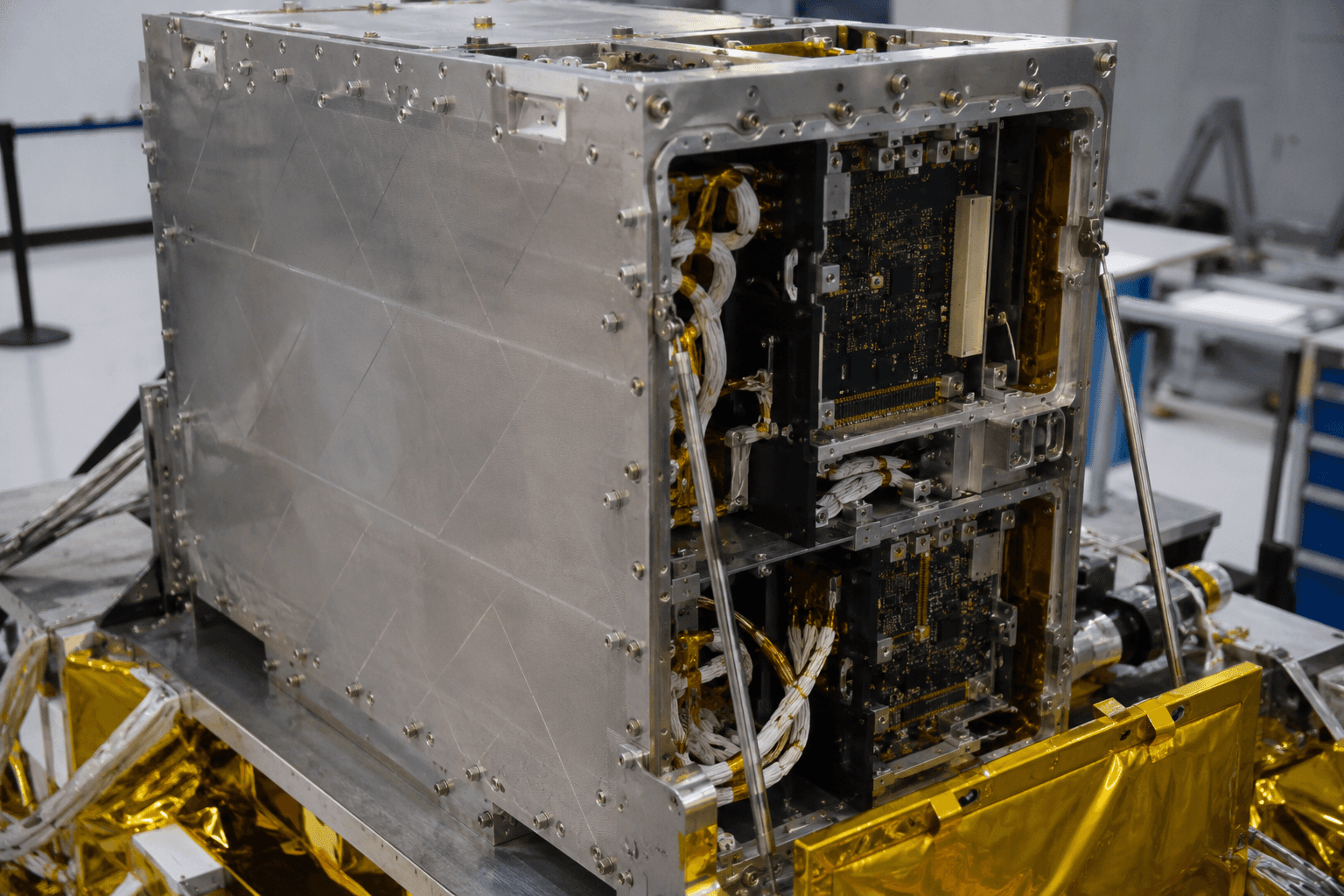
Modern spacecraft increasingly rely on advanced shielding materials to protect sensitive electronics while minimizing launch mass.
Radiation shielding has always been a fundamental part of spacecraft design. Every satellite operating beyond Earth’s atmosphere is exposed to energetic particles capable of degrading electronics, corrupting software, and damaging critical systems over time. For decades, aluminum has served as the industry standard shielding material. It is lightweight compared to many metals, structurally useful, relatively inexpensive, and deeply integrated into spacecraft manufacturing practices. Nearly every spacecraft flying today relies on aluminum in some form for both structure and radiation protection. But modern spacecraft are changing rapidly. Satellites are becoming smaller, more computationally powerful, and increasingly dependent on commercial electronics that are often more sensitive to radiation than traditional space-grade hardware. At the same time, launch mass remains one of the most important economic constraints in spacecraft engineering. These pressures are driving growing interest in advanced shielding materials capable of improving radiation protection efficiency without dramatically increasing spacecraft weight.
Why Spacecraft Need Radiation Shielding
Space radiation comes from several major sources, including trapped particles in Earth’s radiation belts, solar particle events, and galactic cosmic rays originating outside the solar system. Over time, these particles interact directly with spacecraft electronics. Some effects accumulate gradually through Total Ionizing Dose (TID), slowly degrading semiconductor performance over years of operation. Other effects occur instantly when energetic particles trigger single-event effects such as memory corruption, latchup, or transient logic failures. Shielding helps reduce these risks by absorbing and slowing particles before they reach sensitive electronics. The objective is not to eliminate radiation entirely — an impossible task in space — but to lower exposure to levels spacecraft systems can tolerate throughout the mission lifetime. The effectiveness of shielding plays a major role in spacecraft reliability, electronics survivability, mission lifetime, allowable use of commercial electronics, and long-term operational risk.
Why Aluminum Became the Industry Standard
Aluminum became dominant in spacecraft design for practical engineering reasons. With a density of roughly 2.7 g/cm³, aluminum offers a strong balance between structural performance, manufacturability, thermal properties, and weight. Spacecraft structures already rely heavily on aluminum for frames, panels, enclosures, and mechanical supports, making it a natural shielding material as well. Aluminum performs reasonably well against many radiation environments, particularly for reducing cumulative dose exposure in low Earth orbit and moderate trapped particle environments. It is also deeply understood across the aerospace industry. Engineers have decades of flight heritage, qualification data, and manufacturing experience working with aluminum spacecraft structures. For many missions, aluminum remains an effective and practical shielding solution.
The Limitations of Aluminum Shielding
Despite its widespread use, aluminum is not always the most efficient shielding material. One major challenge is mass. Increasing shielding thickness quickly increases spacecraft weight, and every additional kilogram adds launch cost while reducing available payload capacity. This becomes especially problematic for small satellites, CubeSats, compute-heavy spacecraft, long-duration GEO missions, and deep space systems operating under tight mass constraints. Modern missions increasingly rely on commercial processors, AI accelerators, and advanced onboard computing systems that are more radiation-sensitive than older spacecraft electronics. Protecting these systems with aluminum alone may require significant mass increases that are impractical for many spacecraft architectures. Aluminum also interacts imperfectly with certain radiation environments. High-energy electrons and heavy ions can generate secondary radiation effects as they pass through dense shielding materials. While aluminum remains highly useful overall, engineers increasingly look for materials capable of improving protection efficiency per unit mass.
Why Composite Shielding Is Becoming More Important
Advanced composite shielding materials are designed to improve radiation protection while minimizing mass penalties. Many modern shielding composites incorporate hydrogen-rich materials, polymers, nanoparticles, or layered structures engineered to interact more efficiently with incoming particles. Hydrogen-rich materials are particularly attractive because hydrogen atoms are highly effective at slowing energetic protons and reducing secondary neutron production. Compared to traditional aluminum shielding, advanced composites can often provide improved dose reduction efficiency per unit mass, especially in proton-heavy radiation environments. This is increasingly valuable as spacecraft continue shrinking in size while simultaneously demanding greater onboard computational capability. Composite shielding also offers greater design flexibility. Unlike rigid metallic structures, many advanced shielding systems can be molded, coated, layered, or integrated directly around sensitive electronics and subsystems. This allows engineers to focus shielding where it is needed most rather than uniformly increasing spacecraft mass.
Modern Spacecraft Are Driving the Shift
The shift toward advanced shielding materials is largely being driven by changes in spacecraft electronics. Traditional radiation-hardened components remain highly reliable, but they often lag behind commercial electronics in processing capability and efficiency. Modern satellites increasingly depend on commercial-off-the-shelf processors for communications, Earth observation, autonomous navigation, onboard AI processing, and defense applications. These systems deliver enormous performance advantages, but they are also more vulnerable to radiation effects because modern semiconductor geometries are extremely small and sensitive to deposited charge. As a result, shielding is becoming more important not simply for spacecraft survival, but for enabling the use of advanced computing architectures in orbit at all. This is especially true in geostationary orbit and deep space missions, where electronics remain exposed to radiation continuously for many years.
Advanced Shielding Systems and Modern Spacecraft Design
New shielding materials are increasingly being developed specifically for modern spacecraft architectures. Materials such as Melagen’s MLC1 composite shielding systems are designed to improve radiation protection efficiency while maintaining lightweight manufacturability and flexible integration into spacecraft structures. These types of materials are particularly valuable for missions where mass constraints and electronics sensitivity make traditional shielding approaches less efficient. Advanced composites also allow more targeted shielding strategies around high-value electronics, processors, memory systems, and power subsystems without excessively increasing spacecraft-wide structural mass. As spacecraft architectures continue evolving, shielding is becoming less about adding bulk material and more about intelligently managing radiation exposure throughout the spacecraft design.
Radiation Testing Still Matters
No shielding material can be evaluated through theory alone. Ground testing remains essential for understanding how shielding systems perform under realistic radiation conditions. Heavy-ion facilities, proton accelerators, and Total Ionizing Dose testing environments allow engineers to compare shielding effectiveness directly and evaluate how materials behave under prolonged particle exposure. Simulation tools such as GEANT4, SPENVIS, FLUKA, and OMERE also play an important role in predicting particle transport and expected mission dose accumulation. Together, testing and modeling help engineers optimize shielding strategies for specific missions, environments, and spacecraft architectures.
The Future of Spacecraft Shielding
Radiation shielding is becoming more important as spacecraft become more computationally powerful and commercially driven. Aluminum will likely remain a foundational spacecraft material for many years because of its structural advantages and long flight heritage. But advanced composites are increasingly changing how engineers think about radiation protection, especially for missions requiring lightweight architectures and high-performance electronics. Future spacecraft will depend heavily on shielding systems capable of balancing survivability, manufacturability, mass efficiency, and integration flexibility across increasingly demanding radiation environments. As satellites continue evolving, the future of spacecraft shielding will likely belong not to a single material, but to smarter combinations of materials optimized for both protection and performance.
Reach out to learn more
We work closely with our customers to design and build purpose-specific radiation shield solutions for your exact mission parameters and requirements.
We want to ensure you have the radiation protection you need for enhanced mission success.