How Radiation Testing Works: Facilities, Heavy Ions, and Qualification
How Radiation Testing Works: Facilities, Heavy Ions, and Qualification
•
Radiation 101
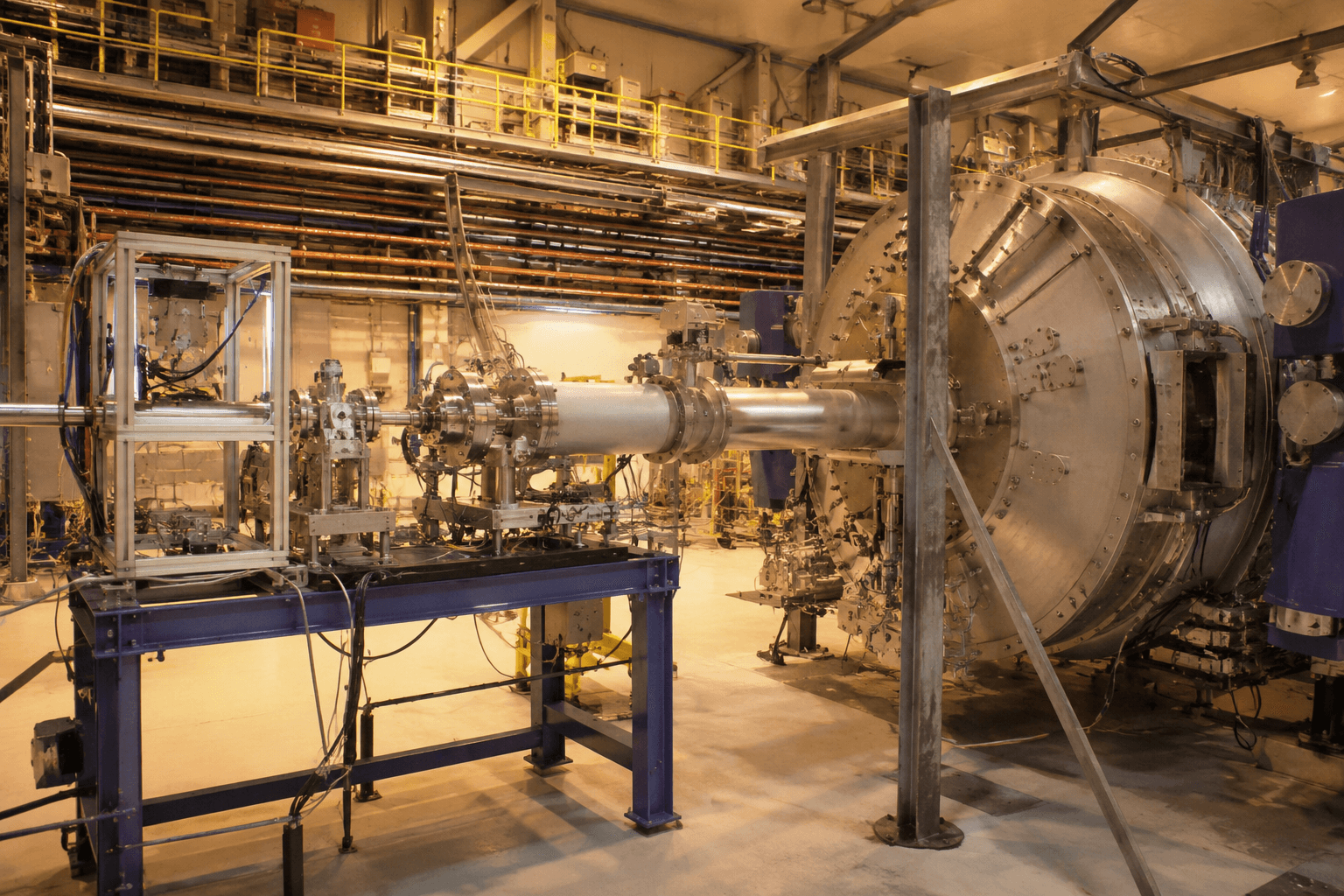
Before electronics ever reach orbit, engineers expose them to particle beams on Earth to understand how they will behave in space.
Spacecraft electronics are expected to survive one of the harshest environments engineers have ever designed for. Once a satellite reaches orbit, repairing failed hardware is often impossible. A single radiation-induced failure can disable communications systems, corrupt onboard computers, damage power electronics, or end a mission entirely. Because of this, spacecraft components are rarely flown without extensive radiation testing beforehand. Radiation testing allows engineers to expose electronics to simulated space environments on Earth before launch. By recreating the energetic particle environments found in low Earth orbit, geostationary orbit, and deep space missions, engineers can evaluate how devices respond to radiation and determine whether they are suitable for flight. Modern spacecraft development depends heavily on this process. Without testing, radiation reliability would largely be guesswork.
Why Spacecraft Electronics Need Radiation Testing
Electronics behave very differently in space than they do on Earth. Earth’s atmosphere and magnetic field shield terrestrial systems from most energetic particles. In orbit, however, spacecraft are continuously exposed to trapped radiation belts, solar particle events, and galactic cosmic rays capable of interacting directly with semiconductor devices. Some radiation effects accumulate slowly over time. Total Ionizing Dose (TID), for example, gradually damages transistor oxides and shifts device behavior over months or years of operation. Other effects occur almost instantly. A single energetic particle can flip a memory bit, corrupt logic, trigger latchup, or permanently damage a component in microseconds. Radiation testing helps engineers understand how much dose a device can survive, how vulnerable it is to single-event effects, and whether it can safely operate in a specific mission environment. These answers directly influence spacecraft architecture, shielding strategy, and mission reliability planning.
Heavy-Ion Testing and Single-Event Effects
One of the most important forms of radiation testing is heavy-ion testing. Heavy ions are highly energetic charged particles capable of depositing large amounts of charge inside semiconductor devices. Similar particles exist naturally in space as part of galactic cosmic rays and solar particle events. When these particles strike sensitive electronics, they can trigger destructive single-event effects inside integrated circuits. During heavy-ion testing, particle accelerators direct controlled ion beams into powered electronic devices while engineers monitor system behavior in real time. The purpose is to evaluate how electronics respond under radiation exposure and identify whether failures such as memory corruption, transient logic interruption, latchup, or burnout occur. One of the most important values measured during testing is the device’s threshold LET, or Linear Energy Transfer. LET describes how much energy a particle deposits while moving through material. Devices with lower latchup or upset thresholds are generally more vulnerable to radiation effects in orbit. By measuring these thresholds, engineers can estimate expected failure rates for specific orbital environments and determine whether additional mitigation strategies are required.
Proton Testing and Total Ionizing Dose Qualification
Heavy ions are not the only radiation threat spacecraft face. Proton testing is commonly used to simulate trapped proton environments such as those encountered in low Earth orbit and portions of the Van Allen radiation belts. Depending on their energy, protons can contribute to both cumulative damage and single-event effects. Total Ionizing Dose testing focuses on long-term degradation rather than immediate failure. During TID testing, electronics are exposed to controlled gamma-ray or x-ray sources that simulate years of accumulated radiation exposure over relatively short periods of time. As dose accumulates, engineers monitor how device performance changes. Parameters such as leakage current, timing behavior, power consumption, and overall functional stability are carefully evaluated to determine whether electronics can survive the intended mission duration. For long-duration missions operating in geostationary orbit, cumulative dose tolerance often becomes one of the most important qualification requirements.
Radiation Testing Facilities Around the World
Radiation testing requires specialized facilities capable of generating controlled particle environments. Heavy-ion accelerators and proton beam facilities are typically operated by government laboratories, national research institutions, and universities. Organizations such as NASA, ESA, TRIUMF, Texas A&M, Brookhaven National Laboratory, and Lawrence Berkeley National Laboratory all support radiation testing used for spacecraft electronics qualification. These facilities allow engineers to expose electronics to carefully controlled radiation beams with adjustable particle species, energies, and LET levels. During testing campaigns, devices are often powered and operating while engineers monitor current draw, upset rates, functional behavior, and recovery response in real time. For spacecraft developers, radiation testing campaigns are often one of the most critical stages of mission qualification before flight.
Radiation Testing Is Becoming More Important
Modern spacecraft increasingly rely on commercial-off-the-shelf electronics because they offer dramatically better computational performance than many traditional radiation-hardened devices. The challenge is that commercial electronics are often much more sensitive to radiation effects. As semiconductor technology continues shrinking, transistor geometries become smaller and operating voltages decrease. This improves performance and efficiency, but also reduces the amount of deposited charge required to disrupt device operation. At the same time, satellites are becoming more dependent on onboard computing for communications, Earth observation, AI processing, navigation, and autonomous operations. This combination makes radiation testing more important than ever. Rather than assuming components will survive in orbit, engineers now rely heavily on measured radiation data to guide shielding strategies, fault tolerance planning, redundancy, and overall spacecraft system design.
Shielding Validation and Radiation Mitigation
Radiation testing also plays a major role in evaluating shielding effectiveness. By exposing shielded electronics to controlled radiation beams, engineers can directly compare how different materials reduce particle exposure and lower radiation-induced failure rates. Traditional aluminum shielding remains widely used throughout the space industry, but advanced lightweight composites are becoming increasingly important as spacecraft mass constraints tighten and commercial electronics become more radiation-sensitive. Materials such as Melagen’s MLC1 shielding composites are designed to improve radiation protection efficiency while minimizing spacecraft mass penalties. Ground testing allows engineers to validate how these materials perform under realistic radiation exposure conditions before deployment in orbit. Simulation tools are valuable, but real testing remains essential because complex particle interactions inside spacecraft structures and electronics cannot always be perfectly predicted computationally.
Designing Spacecraft That Survive Radiation
Radiation testing sits at the center of modern spacecraft reliability engineering. Before launch, engineers must understand how electronics behave under proton exposure, heavy-ion strikes, cumulative dose accumulation, and long-term orbital radiation environments. Without testing, spacecraft would fly with major unknowns surrounding survivability and operational lifetime. As satellites become more autonomous, computationally powerful, and commercially driven, the importance of radiation testing will only continue growing across the space industry. The spacecraft most likely to succeed are not simply the ones with the most advanced electronics. They are the ones whose systems were thoroughly tested, validated, and engineered to survive the realities of space radiation long before they ever leave Earth.
Reach out to learn more
We work closely with our customers to design and build purpose-specific radiation shield solutions for your exact mission parameters and requirements.
We want to ensure you have the radiation protection you need for enhanced mission success.