What Causes Single Event Latchup (SEL)?
What Causes Single Event Latchup (SEL)?
•
Radiation 101
A single energetic particle can permanently damage spacecraft electronics, making SEL one of the most dangerous radiation effects in space.
Space radiation does not always damage electronics slowly over time. In some cases, a single particle striking a semiconductor device is enough to trigger catastrophic failure almost instantly.
One of the most dangerous examples is Single Event Latchup (SEL), a radiation effect capable of creating destructive current paths inside integrated circuits. As spacecraft increasingly rely on advanced commercial electronics and onboard computing, understanding SEL has become critical for designing reliable systems in harsh radiation environments.
What Is Single Event Latchup?
Single Event Latchup occurs when an energetic particle deposits charge inside a semiconductor device and unintentionally activates a parasitic electrical structure within the chip.
Most modern CMOS electronics inherently contain parasitic transistor structures created during fabrication. Under normal operation, these structures remain inactive. However, when a heavy ion or energetic proton deposits enough charge in a sensitive region of the device, it can trigger these parasitic elements into conduction.
The result is a low-resistance current path between power and ground.
Once triggered, the device may begin drawing extremely large currents far beyond normal operating conditions. If the current is not interrupted quickly, the device can overheat, suffer thermal runaway, and fail permanently. In many cases, the latchup condition persists until power is removed entirely.
Why SEL Is More Dangerous Than Other Radiation Effects
Not all radiation effects are equally severe.
Some single-event effects, such as single-event upsets (SEUs), may only flip a memory bit or temporarily corrupt data. Systems can often recover through resets, error correction, or software mitigation.
SEL is different because it directly threatens hardware survival.
A severe latchup event can destroy power regulators, damage processors, burn out transistors, disable payload electronics, or even create cascading subsystem failures. For spacecraft operating millions of kilometers away with no possibility of repair, even a single destructive latchup event can jeopardize an entire mission.
This is why SEL is often treated as one of the highest-priority radiation risks during spacecraft electronics qualification.
What Causes Latchup in Space?
Latchup is fundamentally driven by energetic particle interactions inside semiconductor materials.
Heavy ions are particularly dangerous because they deposit large amounts of charge along their path through a device. If enough charge accumulates in a sensitive region, it can activate the parasitic transistor structures that exist naturally within CMOS architectures.
Several environmental factors increase SEL risk, including high-LET heavy ions, solar particle events, galactic cosmic rays, and long-duration exposure in high-radiation orbits such as GEO.
Device design also plays a major role. As semiconductor technology nodes shrink, transistor spacing decreases and critical charge thresholds become smaller. This improves performance and power efficiency, but it can also make devices more vulnerable to radiation-induced effects.
Modern high-performance commercial processors are therefore often more susceptible to SEL than older or radiation-hardened architectures.
GEO and Deep Space Missions Face Higher SEL Risk
SEL risk varies significantly depending on mission environment.
Low Earth orbit missions often experience frequent SEUs due to trapped protons and South Atlantic Anomaly passes, but destructive latchup rates may remain manageable depending on shielding and mission duration.
Geostationary orbit (GEO), however, presents a much harsher long-term environment. GEO spacecraft operate for years under continuous exposure to energetic particles, increasing cumulative opportunities for latchup events over the mission lifetime.
Deep space missions are even more challenging. Outside Earth's protective magnetosphere, spacecraft are exposed directly to galactic cosmic rays and solar particle events capable of generating high-LET interactions deep within electronics.
As missions become longer and spacecraft rely more heavily on advanced onboard computing, managing SEL risk becomes increasingly important.
How Engineers Mitigate SEL
Because SEL can destroy hardware, mitigation strategies focus on both prevention and rapid recovery.
Radiation-hardened components are specifically designed to reduce susceptibility to latchup and other single-event effects. These devices often use specialized fabrication techniques and layouts to suppress parasitic conduction paths.
Shielding also plays an important role. By reducing the number of energetic particles reaching sensitive electronics, shielding lowers the probability of latchup events over time. Lightweight advanced shielding materials such as Melagen's MLC1 composites are designed to improve radiation protection efficiency while minimizing spacecraft mass penalties.
System-level protection is equally important. Many spacecraft include current limiting circuitry, watchdog systems, automatic power cycling, fault detection and isolation, and redundant architectures that help spacecraft recover quickly if a latchup event occurs before permanent damage develops.
Modern spacecraft rarely rely on a single mitigation strategy alone. Instead, engineers combine shielding, component selection, fault tolerance, and testing to reduce overall mission risk.
Testing for SEL Before Flight
Because latchup can be mission-ending, SEL susceptibility testing is a critical part of spacecraft electronics qualification. Engineers must understand not only whether a device can experience SEL, but also how frequently it may occur under the radiation conditions expected during a mission.
To evaluate this risk, heavy-ion accelerators are used to expose devices to controlled radiation environments that simulate space conditions. During testing, engineers monitor current draw, functional behavior, and recovery characteristics to observe how components respond when struck by energetic particles.
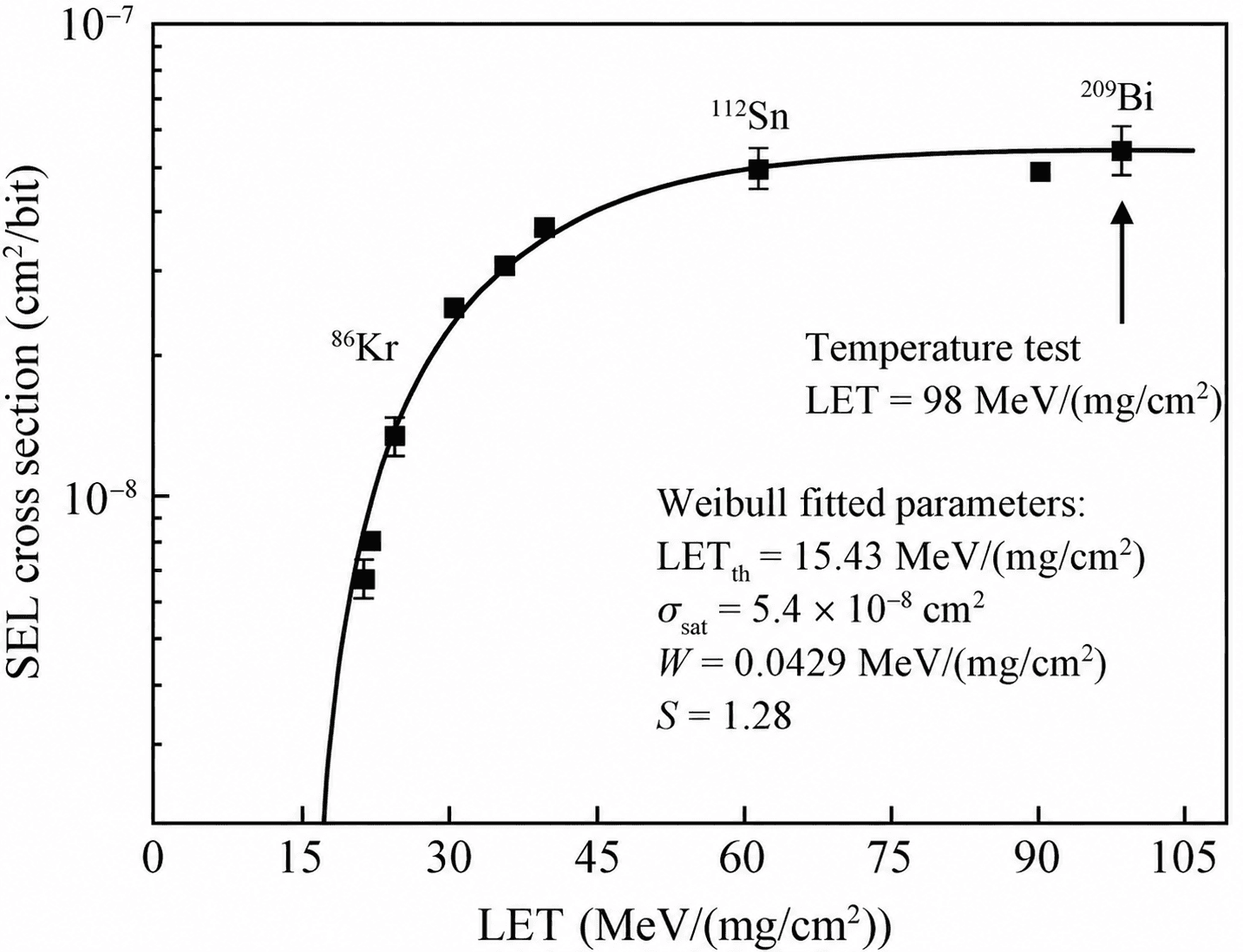
One of the most important outputs of this testing is the Weibull curve shown above. The curve plots SEL cross section versus LET (Linear Energy Transfer), illustrating how the probability of latchup changes as particle energy increases. At low LET values, a device may show little or no susceptibility to latchup. Once the LET exceeds the threshold region, however, the SEL cross section rises rapidly before eventually reaching saturation.
From this curve, engineers extract key Weibull parameters such as threshold LET, curve shape, and saturation cross section. These values are then used to estimate expected latchup rates in specific mission environments using modeling tools such as SPENVIS, CREME96, and OMERE. In practical terms, the Weibull fit helps determine whether a component is likely to survive harsh radiation environments such as GEO or deep space, where high-LET particles are more common.
The analysis does not stop at the component level. Engineers also combine SEL testing data with shielding analysis and system-level mitigation strategies to reduce overall mission risk. Advanced shielding approaches, including lightweight materials such as Melagen's MLC1 composites, can help reduce particle exposure while minimizing spacecraft mass penalties.
Testing also helps determine whether additional fault protection, power management, or architectural changes are required before flight. Without proper validation, spacecraft teams risk deploying electronics with poorly understood radiation vulnerabilities that could ultimately jeopardize an entire mission.
Designing Electronics That Survive Space
Single Event Latchup is one of the clearest examples of how space radiation can fundamentally change electronics behavior.
A single energetic particle can trigger destructive current flow inside a device that otherwise operates perfectly on Earth. As spacecraft increasingly depend on advanced commercial processors, AI hardware, and high-density electronics, understanding SEL becomes even more important.
Designing reliable spacecraft therefore requires more than simply selecting powerful electronics. Engineers must understand how radiation interacts with semiconductor devices, how latchup occurs, and how shielding, testing, and fault tolerance work together to keep systems operational in space.
In harsh environments such as GEO and deep space, survival often depends on whether those risks were accounted for long before the spacecraft ever leaves the ground.
Reach out to learn more
We work closely with our customers to design and build purpose-specific radiation shield solutions for your exact mission parameters and requirements.
We want to ensure you have the radiation protection you need for enhanced mission success.